PLANTOGRAM · CLINICIAN EDUCATION
Multi-System Drivers and Formulation Philosophy
Understand how sleep, pain, stress and interacting body systems inform a multi-pathway formulation model, with practical questions for clinical review.
Start with the patient’s presentation
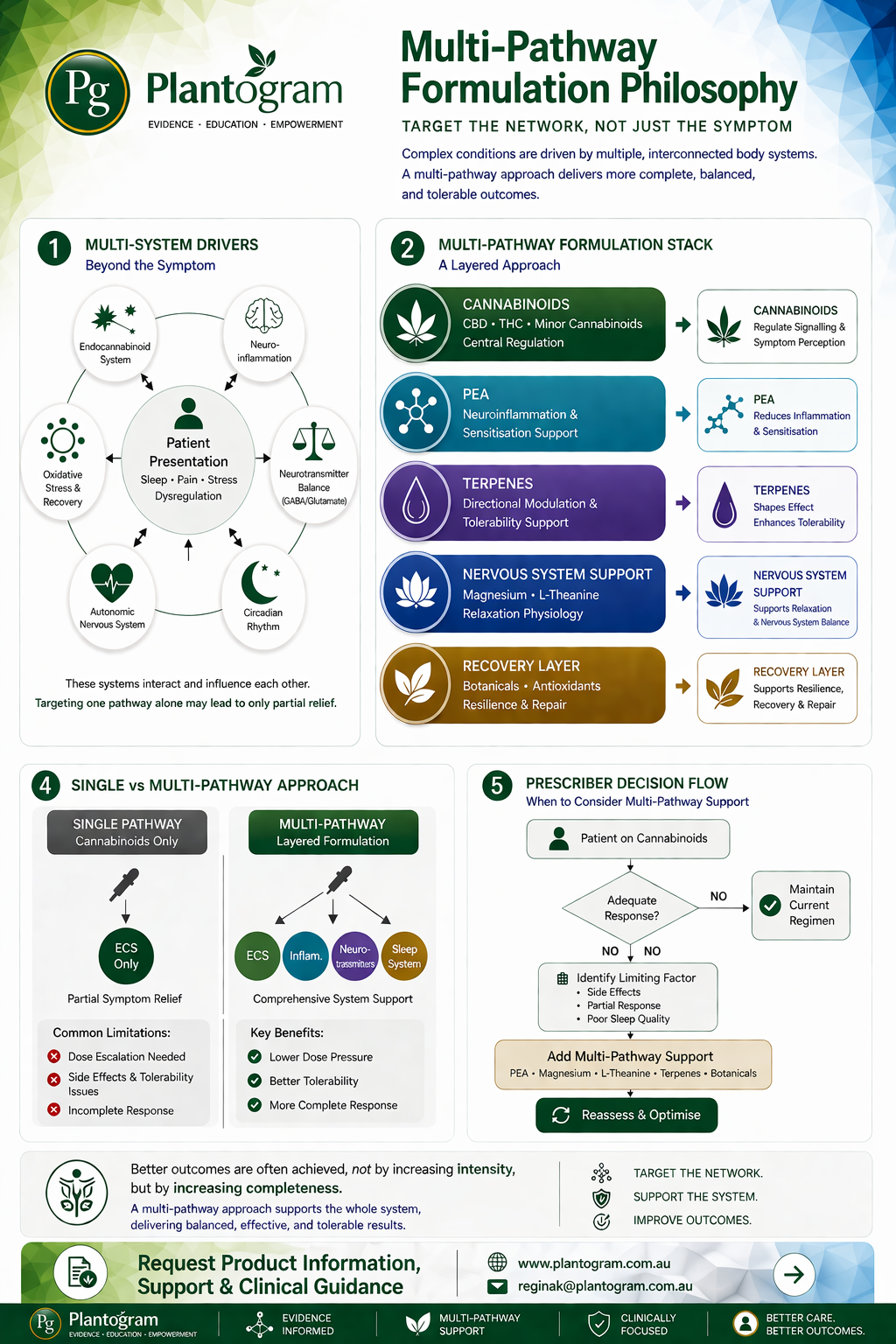
The second module explains the reasoning behind a layered formulation approach. It places the patient’s sleep, pain, stress and dysregulation symptoms at the centre of a network. The diagram is a conceptual map, not a diagnostic test or a validated prescribing algorithm.
Six interacting assessment domains
The framework considers the endocannabinoid system, neuroinflammation, neurotransmitter balance including GABA and glutamate, circadian rhythm, autonomic nervous system activity, and oxidative stress and recovery. These domains can interact, but symptoms alone cannot identify a specific biochemical imbalance.
Assessment should also consider diagnosis, previous treatments, medicines, mental health, sleep routines and functional goals. A complex presentation does not necessarily require a complex formulation.
| Formulation layer | Concept represented | Evidence question |
|---|---|---|
| Cannabinoids | CBD, THC and minor cannabinoids; signalling and symptom perception. | What evidence applies to this condition, route and dose? |
| PEA | A lipid-signalling component considered in inflammation and sensitisation research. | Does evidence support the included dose and preparation? |
| Terpenes | A proposed modulation layer. | Are the claimed effects demonstrated in humans at relevant exposure? |
| Nervous system support | Magnesium and L-theanine appear as examples. | Is there a relevant indication, deficiency or supported clinical objective? |
| Recovery layer | Botanicals and antioxidants appear as examples. | Is there evidence of benefit and acceptable interaction risk? |
Single intervention and layered treatment
A layered model considers other contributors to symptoms alongside cannabinoid exposure. It is a care-planning principle rather than proof of a lower THC requirement or a superior safety profile. A single intervention may remain the simplest appropriate treatment.
A corrected clinical decision sequence
First assess whether the current regimen is effective and tolerated. If it is, review and maintain it when appropriate. If response is inadequate, identify the limiting issue: adverse effects, partial response, poor sleep, adherence, diagnosis or timing.
Consider evidence-based options, which may include modifying or stopping treatment, addressing a separate condition, or selecting an appropriate adjunct. Introduce one change at a time and reassess symptoms, function and harms.
What does “completeness” mean here?
Completeness means examining relevant contributors to the patient’s presentation. It does not mean adding every ingredient layer. A complete assessment can result in a simpler regimen, a non-drug intervention, or referral.
Source resource
Download Multi-System Drivers and Formulation Philosophy
Further reading
- TGA: accessing medicinal cannabis for a patient
- TGA: information directed exclusively to health professionals