PLANTOGRAM · CLINICIAN EDUCATION
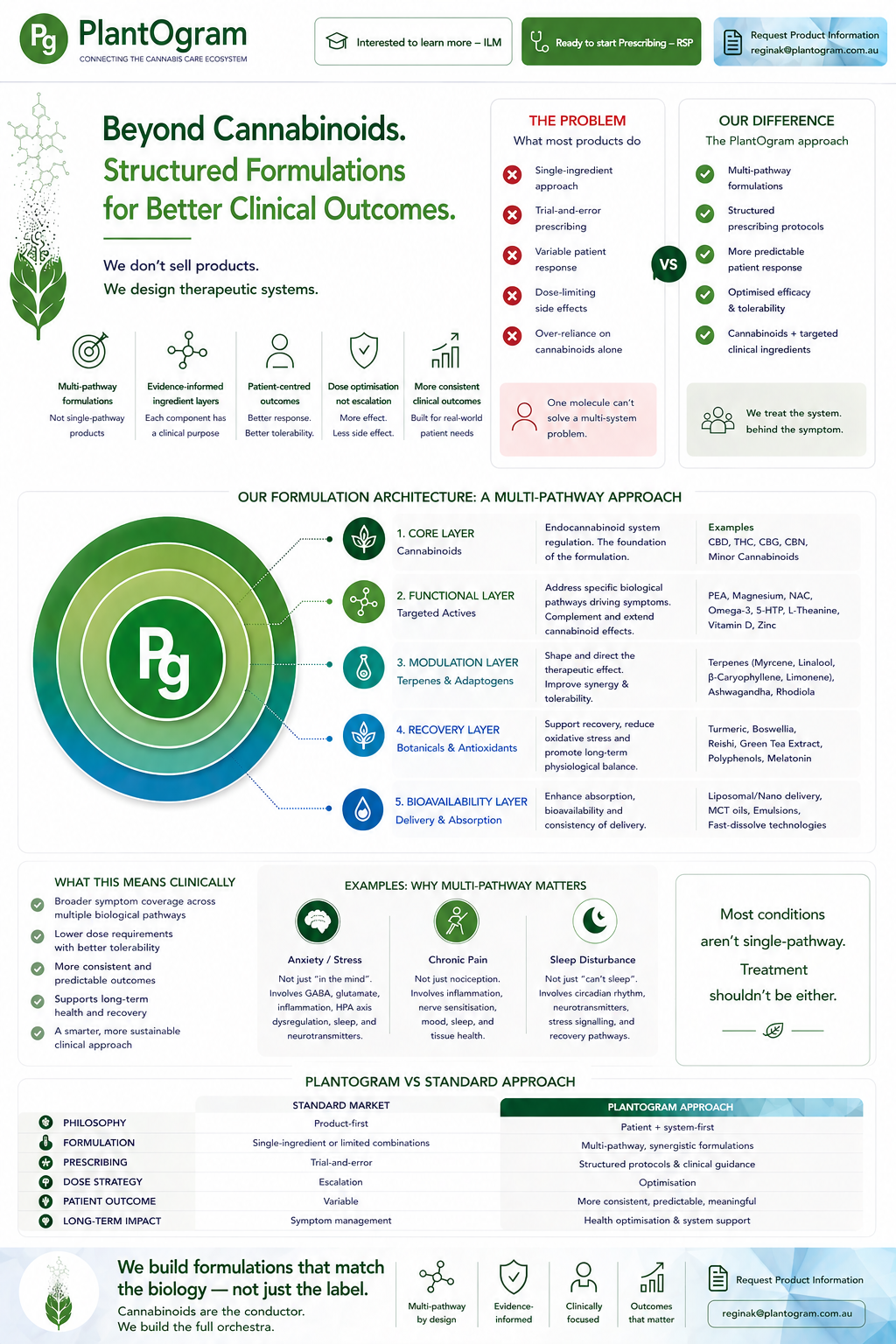
Multi-Pathway Formulation Architecture
Explore a five-layer formulation model: cannabinoids, targeted ingredients, terpenes, recovery components and delivery. Read the evidence limits.
Beyond cannabinoids: a layered formulation model
Multi-pathway formulation describes a proposed approach to combining ingredients with different biological targets. PlantOgram’s model considers the patient’s presentation alongside the composition, delivery and evidence supporting each ingredient. It is a formulation framework, rather than proof that a combination is more effective than an individual medicine.
The objective is to give each ingredient a defined purpose and assess whether it contributes to a measurable outcome. More ingredients do not automatically produce better treatment. Compatibility, dose, interactions and the quality of human evidence remain central.
Five layers of formulation design
The formulation model has five interconnected layers. These examples describe the scope of the model rather than a recommendation to combine the substances.
| Layer | Purpose in the model | Examples shown in the illustration |
|---|---|---|
| 1. Core: cannabinoids | Consider cannabinoid signalling within the wider clinical context. | CBD, THC, CBG, CBN and other minor cannabinoids. |
| 2. Functional: targeted ingredients | Identify additional targets relevant to the presentation. | PEA, magnesium, NAC, omega-3, 5-HTP, L-theanine, vitamin D and zinc. |
| 3. Modulation: terpenes and adaptogens | Examine whether accompanying constituents have a relevant and supported role. | Myrcene, linalool, beta-caryophyllene, limonene, ashwagandha and rhodiola. |
| 4. Recovery: botanicals and antioxidants | Consider recovery-related factors without assuming ingredient effects translate to the combination. | Turmeric, Boswellia, reishi, green tea extract, polyphenols and melatonin. |
| 5. Bioavailability: delivery and absorption | Assess how formulation changes exposure and consistency. | Liposomal or nano delivery, MCT oils, emulsions and fast-dissolving technologies. |
Why consider more than one biological pathway?
Pain, disturbed sleep and stress can overlap with several biological and psychosocial processes. The source illustration uses anxiety and stress, chronic pain and sleep disturbance as examples. Relevant assessment domains may include inflammation, sensitisation, circadian timing, stress responses, medication effects and daily function. A clinician must establish which factors actually matter for the individual.
A biological rationale does not establish that every listed ingredient is useful, that a patient has a pathway deficiency, or that changing a pathway improves a clinical condition.
From formulation philosophy to measurable outcomes
The model prioritises patient assessment, a clearly defined role for each ingredient, structured review and dose optimisation.
Claims of lower doses, fewer side effects, more predictable responses or better long-term outcomes require evidence for the actual formulation, dose and population. These outcomes should be measured rather than presumed.
Questions to ask about a multi-ingredient formulation
What human evidence supports each ingredient at the included dose? Has the complete combination been studied? Does the delivery system change exposure? Could ingredients interact with medicines or duplicate existing treatment? What improvement would justify continuing the formulation?
Does combining cannabinoids and terpenes prove synergy?
No. Complementary mechanisms can support a research hypothesis, but synergy requires evidence that the combination has an effect beyond the relevant comparison. A terpene profile alone does not establish clinical efficacy or tolerability.
Source resource
Download Multi-Pathway Formulation Architecture
Further reading
- TGA: accessing medicinal cannabis for a patient
- TGA: information directed exclusively to health professionals